Look Up Saturday: The Space Station Passes Nearly Straight Over Middleburg
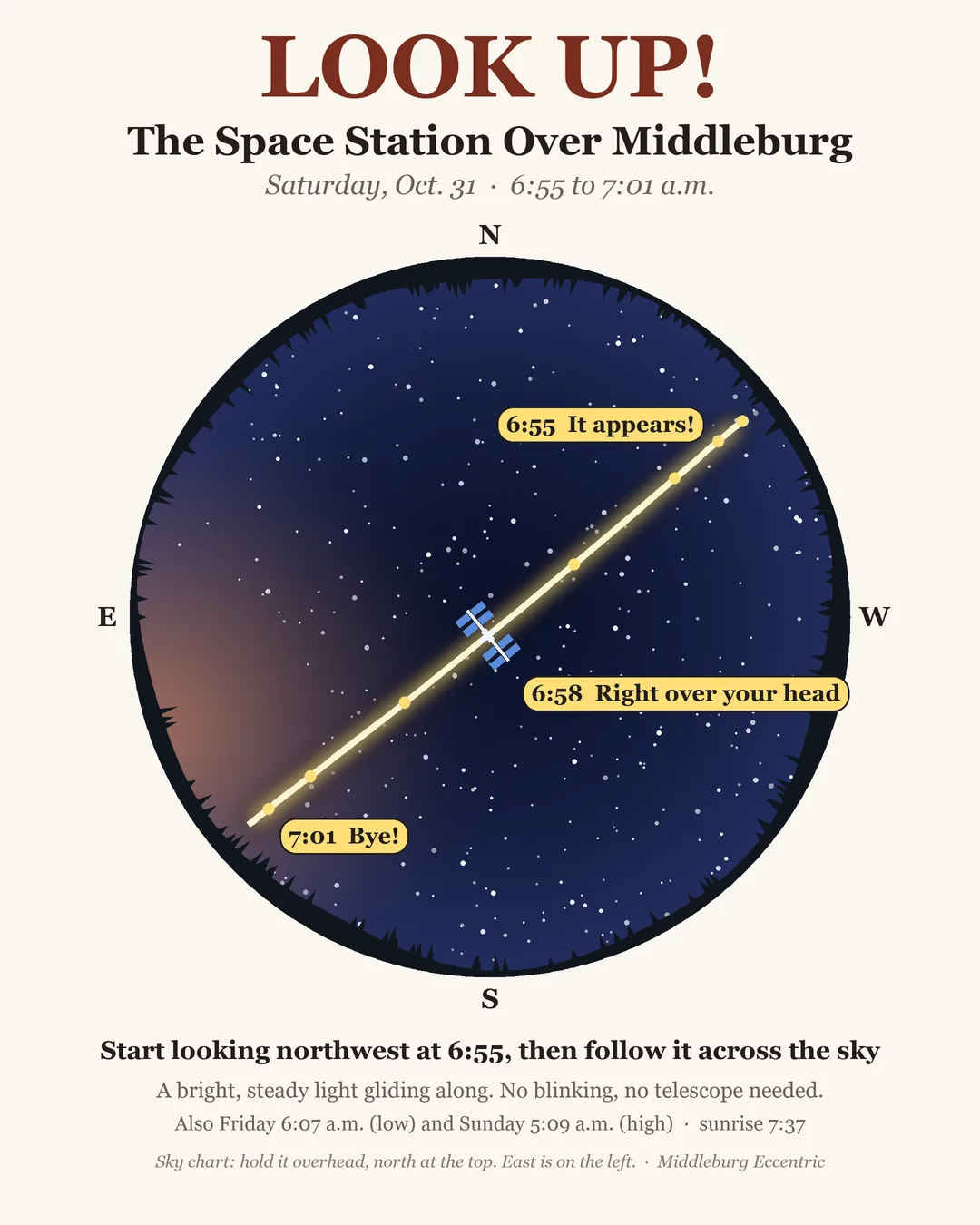
If you're up before sunrise on Saturday, step outside at about 6:55 a.m. The International Space Station will cross the sky over Middleburg, and this time it passes almost directly overhead.
## When and where to look
Saturday, October 31, from about 6:55 to 7:01 a.m.
The station rises out of the northwest, climbs to nearly straight overhead at about 6:58, and fades into the southeast a little after 7:01. From Middleburg it stays in view for nearly seven minutes.
It looks like a very bright, steady star moving smoothly across the sky. It doesn't blink, which is how you tell it from an airplane. At its highest it will be about 265 miles away, as close as it gets, so it will be one of the brightest lights in the sky.
Sunrise is at 7:37, so the sky will already be getting light in the east. That's fine: the station is bright enough to see in morning twilight.
## Two more chances
- Friday, October 30, about 6:07 to 6:11 a.m.: lower in the sky, rising in the north-northwest and setting in the east.
- Sunday, November 1, about 5:09 to 5:14 a.m.: a good, high pass, from the north-northwest to the east-southeast. Clocks fall back an hour early Sunday morning, so that's standard time.
## Tips
- Go out a few minutes early and let your eyes adjust.
- Find a spot with a clear view to the northwest. Middleburg's hills and trees block a lot of horizon, so an open field or a hilltop helps.
- No telescope or binoculars needed.
- Check the clouds before you go out. A clear sky is all it takes.
The station orbits about 260 miles up and goes around the Earth every 93 minutes, at roughly 17,500 miles an hour. NASA's free Spot the Station service will send an alert before future passes over your town.
How we figured it: the times and directions above were calculated for Middleburg from the station's published orbit data. Other news sources list times for other places; Norfolk's pass, for example, comes at a different angle. Small adjustments to the station's orbit can shift a pass by a minute or two.