Three Questions on Your Ballot: What a Yes or a No Means
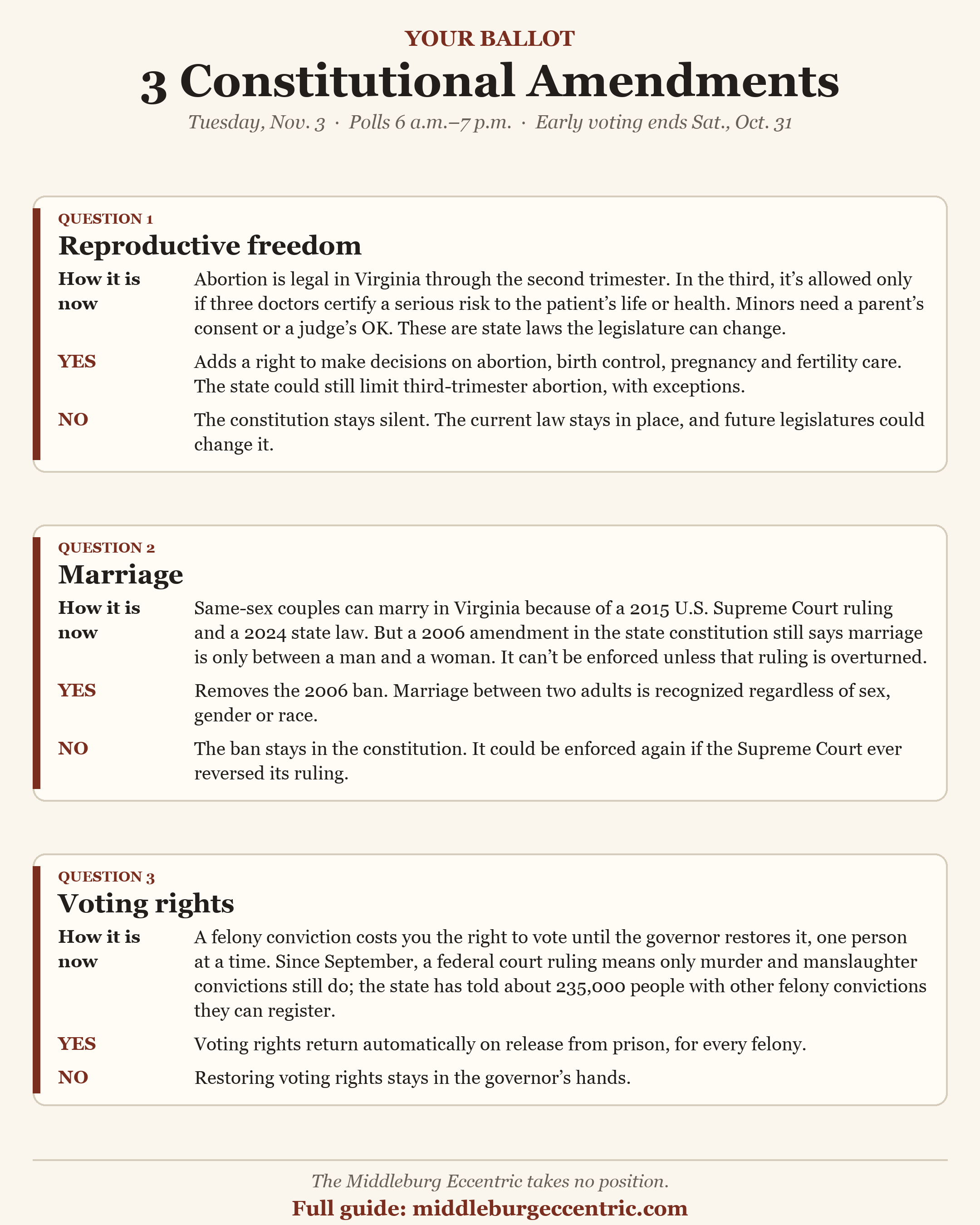
Besides the races for U.S. Senate and Congress, every Virginia ballot on Tuesday carries three proposed amendments to the state constitution: on reproductive freedom, on marriage, and on voting rights after a felony conviction.
Each one has already passed the General Assembly twice, in 2025 and again in January 2026, which is what the constitution requires before an amendment goes to voters. The governor has no say. If a majority votes yes, the change becomes part of the Constitution of Virginia. If a majority votes no, the constitution stays as it is.
The Eccentric takes no position on any of the three. Below, for each question, is what it says, what changes with a yes or a no, what it means for you, for Middleburg, for Virginia and beyond, and the strongest case on each side, in the words of the people making it.
## Before you vote
- Early voting in person ends Saturday, October 31. Loudoun's early voting sites include the Office of Elections, 750 Miller Drive SE, Leesburg, and the Carver Senior Center in Purcellville. There is no early voting site in Middleburg.
- On Election Day, Tuesday, November 3, polls are open 6 a.m. to 7 p.m. Anyone in line at 7 may vote.
- Mail ballots can be dropped off by 7 p.m. on Election Day, or mailed if postmarked by November 3 and received by noon on November 6.
- Questions: Loudoun County Office of Elections, 703-777-0380; Fauquier County General Registrar, 528 Waterloo Road, Warrenton.
Where to vote, according to the Loudoun and Fauquier county election offices. Not sure of your precinct? Look it up at vote.elections.virginia.gov.
- Middleburg (Loudoun Precinct 307): Middleburg Town Hall, 10 W. Marshall Street
- Aldie (Loudoun Precinct 309): Aldie Methodist Church, 39325 Little River Turnpike
- The Plains (Fauquier Precinct 505): Grace Episcopal Church, 6507 Main Street, The Plains
- Salem (Fauquier Precinct 401): Marshall Middle School, 4048 Zulla Road
- Hopewell (Fauquier Precinct 501): Coleman Elementary School, 4096 Zulla Road
- Leeds (Fauquier Precinct 402): Emmanuel Episcopal Church, 9668 Maidstone Road, Delaplane
## Question 1: Reproductive freedom
What it says. "Should the Constitution of Virginia be amended to (i) protect the freedom to make personal decisions about prenatal care, childbirth, postpartum care, birth control, abortion, miscarriage management, and fertility care; (ii) protect doctors, nurses, and patients from being punished for these decisions; and (iii) allow for restrictions on access to abortion during the third trimester of pregnancy except when the patient's health is at risk or the pregnancy cannot survive?"
What changes with a yes. The constitution would gain a "fundamental right to reproductive freedom." The state could limit that right only for a "compelling state interest achieved by the least restrictive means," a high legal bar. The state could still regulate third-trimester abortions, but could not ban one a physician judges necessary to protect the patient's life or physical or mental health, or when the fetus is not viable. No one could be prosecuted over their own pregnancy outcome, including a miscarriage or stillbirth.
What stays with a no. The constitution stays silent on abortion. Virginia's current rules remain, but they are ordinary laws, which any future General Assembly and governor could loosen or tighten. Today, abortion is legal in the first and second trimesters. In the third, it requires three physicians to certify that continuing the pregnancy would likely kill the patient or seriously and permanently harm her health. A minor needs a parent's consent or a judge's approval. Virginia repealed its 24-hour waiting period and ultrasound requirement in 2020.
For you. Day to day, a yes vote would not change much: the amendment's sponsors say it was written to track current law. What it changes is permanence. Today's rules can be rewritten in any legislative session; a constitutional right can be changed only by another amendment and another statewide vote. The open question is how courts would apply the "least restrictive means" test to existing laws, such as parental consent and the three-physician rule. Supporters and opponents disagree sharply on that, and the answer would come from the courts.
For Virginia and the country. Virginia is the only state in the South that does not ban abortion, according to KFF, a health policy research group. Since 2022, voters in 12 states have passed abortion-rights ballot measures, including Ohio, Arizona and Missouri.
The case for. "We really based it on the current laws that we have on the books," said Sen. Jennifer Boysko, D-Fairfax, the Senate sponsor, who has described nearly dying of preeclampsia in pregnancy. "Individuals are tired of their freedom being a political football," said House Majority Leader Charniele Herring, D-Alexandria, the House sponsor, who said the amendment "does not directly address parental consent. So our parental consent law would still be on."
The case against. Victoria Cobb, president of The Family Foundation, argues the standard is so broad that ordinary safety rules could fall: "Technically, an inspection could be seen as a burden. So could a license or a building standard." Dr. Timothy Bowley, an obstetrician with Virginia Medical Professionals for Women's Safety, called it "so vague and broad-reaching that it covers all aspects of reproductive care." Opponents argue the amendment would override the state's parental-consent law; its sponsors say it would not. Republican senators tried to add parental-notification language in 2026; Democrats voted it down.
In court. Two lawsuits argue the amendment was not properly advertised before the 2025 House election, as a now-repealed state law required. One, dismissed in Campbell County in July, is on appeal at the Court of Appeals of Virginia. In the other, a Tazewell County judge has set a hearing for November 13 on whether to block certification of the result if the amendment passes. Earlier this year, a different amendment, on redistricting, was approved by voters in April and then struck down by the Supreme Court of Virginia.
## Question 2: Marriage
What it says. "Should the Constitution of Virginia be amended to (i) remove the ban on same-sex marriage; (ii) affirm that two adults may marry regardless of sex, gender, or race; and (iii) require all legally valid marriages to be treated equally under the law?"
What changes with a yes. The 2006 Marshall-Newman Amendment comes out of the constitution. That language says only "a union between one man and one woman" may be a valid marriage in Virginia, and bars civil unions. In its place, the constitution would call marriage "one of the vital personal rights essential to the orderly pursuit of happiness" and require the state to license and recognize marriages between two adults "regardless of the sex, gender, or race of such persons."
What stays with a no. Nothing changes in practice today. Same-sex couples marry in Virginia under the U.S. Supreme Court's 2015 Obergefell decision, and a 2024 Virginia law, signed by Gov. Glenn Youngkin, also provides for it. But the 2006 ban would stay in the constitution, unenforceable for now. The state's official explanation says it "would be enforceable again" if the Supreme Court reversed Obergefell.
For you. If you are married, or plan to be, nothing changes the day after the election either way. The question is what Virginia's own constitution would say if federal law ever changed. Opponents also raise a different concern: whether the words "sex, gender" could reach beyond marriage.
For Middleburg. When the ban was adopted in 2006, Virginia approved it with 57 percent of the vote and Loudoun County with 54 percent. Middleburg's precinct went the other way: 291 yes, 347 no, according to the state's official returns. (Precinct lines have shifted some since.)
For the country. Voters in Nevada, California, Colorado and Hawaii have removed similar bans since 2020. The U.S. Supreme Court declined, in November 2025, to take up a request to revisit Obergefell.
The case for. "It's not a radical change, it's just bringing Virginia into the current status of the law of the land," said former Sen. Adam Ebbin, the amendment's longtime sponsor. "We want Virginians to ensure that all Virginia families know that their state constitution respects their relationship," said Narissa Rahaman of Equality Virginia Advocates. Three House Republicans and five Senate Republicans voted for it in 2026.
The case against. "There are no protections for those who have deeply held religious beliefs," said former Lt. Gov. Winsome Earle-Sears, who has also said she supports civil unions. Republican legislators tried to add protection for clergy and churches that decline to perform marriages; Democrats rejected it. Pastor Jonathan Falwell of Thomas Road Baptist Church in Lynchburg argued that the wording "would separate the idea of sex and gender, in our constitution," with effects beyond marriage. John Fishwick, a former U.S. attorney, told WSET he reads the amendment as "limited to marriage."
In court. A Prince William County pastor sued October 22, making the same advertising argument as the Question 1 challenges. It will not be heard before Election Day.
## Question 3: Voting rights
What it says. The question asks whether the constitution should be amended "(i) to provide for the fundamental right to vote in the Commonwealth, (ii) to revise the qualifications of voters so that a person convicted of a felony is not entitled to vote during his period of incarceration but is automatically invested with the right to vote upon release from incarceration, (iii) to update the existing prohibition on voting by persons found to be mentally incompetent to instead apply to persons who have been found to lack the capacity to understand the act of voting."
What changes with a yes. Anyone convicted of a felony would regain the right to vote automatically on leaving prison, even while still on probation or parole or still owing fines or restitution. The constitution would also declare voting a "fundamental right," and would bar from voting only those a court finds lack "the capacity to understand the act of voting," replacing the broader "mentally incompetent."
What stays with a no. Restoring a felon's right to vote stays in the governor's hands. That power has swung with each administration: Govs. Terry McAuliffe and Ralph Northam restored rights to more than 173,000 and 126,000 people respectively; Gov. Glenn Youngkin restored fewer than 10,000 over his term; Gov. Abigail Spanberger had restored 66,085 by July, according to her office.
The federal ruling. Much of this has already changed. In January, U.S. District Judge John Gibney ruled that Virginia's automatic disenfranchisement violates the 1870 federal law under which Virginia was readmitted to the Union. Since September 15, the state has barred from voting only people convicted of murder or manslaughter, and it has mailed 234,852 Virginians to tell them they may register. So a yes vote now mainly writes automatic restoration into the constitution, where it would not depend on a governor's policy or on the court ruling surviving any appeal, and extends it to the few crimes still disqualifying.
For you. If you or someone in your family has a felony record, a yes vote means the right to vote returns the day of release, without an application. A no vote leaves it to the courts and to whoever is governor.
For Virginia and the country. Virginia is one of 10 states where some people lose the vote for life unless a governor or other authority acts, according to the National Conference of State Legislatures. Twenty-three states, including Maryland and Pennsylvania, restore voting rights automatically on release from prison, as Question 3 would.
The case for. "No one returning from incarceration knows what steps they need to take to get their rights restored," said Sen. Elizabeth Bennett-Parker, D-Alexandria, the sponsor. Sergio Hayes, a formerly incarcerated advocate, called the current system "not restoration, that's permission." Even the Founding Freedoms Law Center, which is challenging Questions 1 and 2 in court, has no position on this one. "We're not personally concerned about the restoration-of-rights amendment," said Josh Hetzler, a lawyer for the group.
The case against. House Minority Leader Terry Kilgore, R-Scott County, says he supports reform but objects that the amendment "lets a felon who is still on probation, still owes fines" vote. Republican senators proposed limiting automatic restoration to nonviolent offenses and requiring restitution and completed probation first.
In court. No lawsuit against Question 3 has been reported.
## One more thing to know
All three amendments, if approved, would take effect as part of the constitution, which only another amendment and another statewide vote can change. That permanence is the real stake in each question, for supporters and opponents alike.